
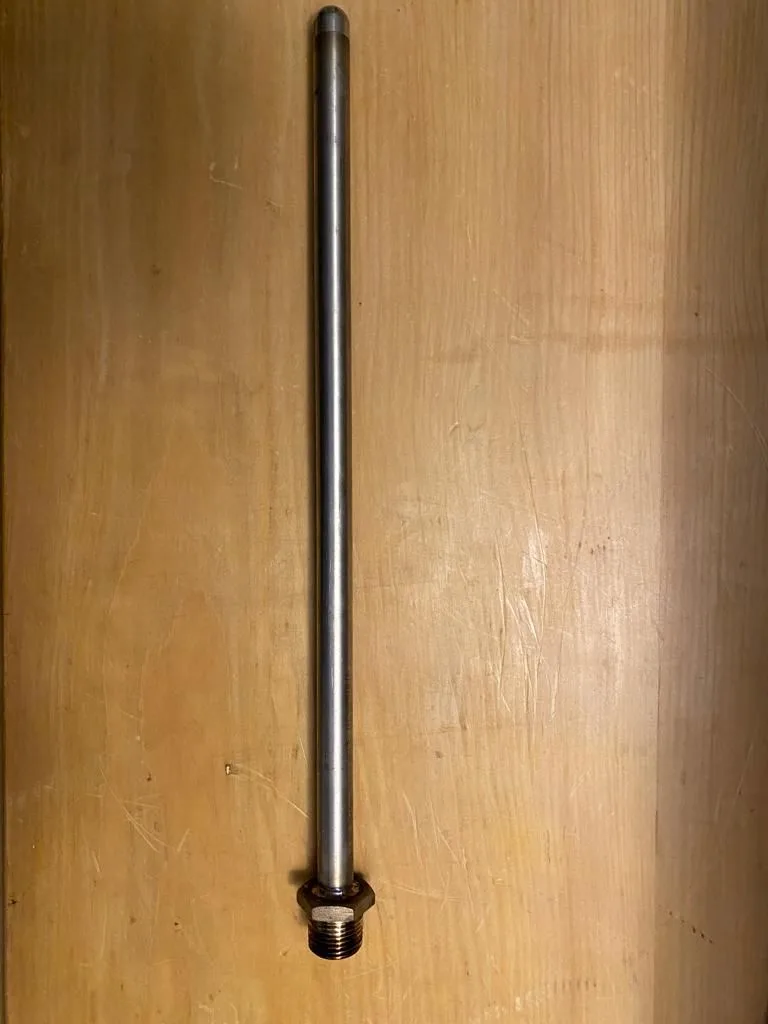
Screw-Fit Stainless Steel Thermocouple Sheaths for Fire Assay Furnaces
Protective stainless steel sheaths for thermocouples used in high-temperature fire assay furnaces.
Key benefits of our Stainless Steel Thermocouple Sheath
Enhanced Safety Systems
Multiple safety features including independent over-temperature protection, automatic shutdown, and door interlock ensure safe laboratory operation.
Precise Temperature Control
Digital PID controller maintains temperature stability within ±2°C for reproducible drying conditions and consistent analytical results.
Compact footprint design
Space-efficient design that fits into almost any plant layout while reducing the required plant footprint significantly.
Reliable Temperature Protection
Designed to protect thermocouples from mechanical damage, oxidation, and chemical exposure in fusion and cupellation furnaces.
Secure Screw-Fit Installation
Threaded design ensures stable mounting and accurate temperature measurement.
Supports Precise Furnace Control
Enhances temperature stability and measurement reliability in precious metal assay operations.
Applications for our Stainless Steel Thermocouple Sheath
Discover how our Stainless Steel Thermocouple Sheath can be used in various industries and applications.

Mining & Exploration
Reliable solutions for mining and exploration operations in challenging environments

Industrial Projects
Comprehensive solutions for large-scale industrial projects and operations
Frequently asked questions
FAQs for the Stainless Steel Thermocouple Sheath
What is Fire Assay and why is it used?
Fire Assay is a highly accurate laboratory method used to determine the precious metal content in ores, concentrates, and geological samples. The process uses high temperatures to separate gold, silver, platinum group metals, and other valuable elements from surrounding material. Because of its precision and reliability, Fire Assay is considered the industry standard for precious metal analysis worldwide.
How does the Fire Assay process work?
The sample is first mixed with special fluxes and heated in a furnace at very high temperatures. During melting, precious metals collect into a lead or nickel button while unwanted material forms slag. The metal button is then separated and further refined to accurately measure the precious metal content. This process delivers highly reliable results, even at very low concentrations.